20 November — annually
Founder’s Memorial Observance
In remembrance of the late Rev. Dr. Zengaku Soyu Matsuoka-roshi, Archbishop of Soto Zen Mission North America.
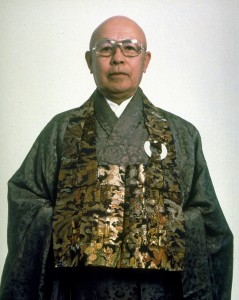
The late Rev. Dr. Zengaku Soyu Matsuoka-roshi
Archbishop Soto Zen Mission North America
25 November 1912 – 20 November 1997
This temple and all works done here are respectfully dedicated to Rev. Dr. Zengaku Soyu Matsuoka-roshi, Archbishop Soto Zen North America.
— Reverend Daito Zenei Eric Thompson, Oshō,
director Sarasota Zen Center — Zen Buddhist Temple.
Moku-rai
Silence is thunder.
“Moku-rai” is one of Matsuoka-roshi’s favorite and frequently spoken terms. Its importance to him is illustrated by the calligraphy scrolls that he brushed to express it, one of which appears here. It represents the resolution of opposites, and is translated as “Silence is Thunder,” “Silence is Great Action,” or “Stillness in Motion” (“Motion in Stillness”). When one awakens to enlightenment, one hears this thunder that is silence; one experiences the motion that is stillness.
Our Soto Zen lineage traces its roots to Japan through its founding pioneer in America, Zengaku Soyu Matsuoka Roshi (1912–1997). The 13th Century founder of Soto Zen in Japan, Master Eihei Dogen (1200–1253), received Soto Transmission from his teacher Master Nyojo in China, and had received Rinzai Transmission from Master Eisai in Japan. An unbroken line of teachers and students from Master Dogen to Matsuoka Roshi means that we share both great ancestral lineages from Japan, China and India.
Matsuoka Roshi was one of the first generation of Zen Priests to move to the USA, arriving here in 1939. O-sensei transmitted the genuine practice of Master Dogen as a missionary to the country that, soon after, went to war with his homeland. Matsuoka Roshi was the first—or one of the first—Zen masters to emphasize zazen for Westerners.
Life & Lineage
A pioneer of American Zen.
Zengaku Soyu Matsuoka-roshi is an important historical figure in the propagation of Soto Zen in the United States. Matsuoka-roshi was born in Japan, in Yamaguchi Prefecture near Hiroshima on November 25, 1912, into a family which had a history of Zen priests dating back six centuries. He attended Komazawa University in Tokyo, where he graduated with a bachelor’s degree. From there, he studied and practiced Zen at Sojiji Zen Monastery. After several years at Sojiji, he was given an assignment to establish a Zen Temple in northern Japan, on Karafuto (Sakhalin) Island. Prior to his coming to America, Matsuoka-roshi earned a Ph.D. in philosophy, from Political Science University in Tokyo.
In 1939, Soto Zen Headquarters asked him to travel to the United States, where he first became an assistant minister at the Los Angeles Zen Buddhist Temple, and later the Superintendent of the San Francisco Zen Buddhist Temple, which became the San Francisco Zen Center. After serving as a Zen Priest on the West Coast of the U.S., he attended Columbia University in New York, where he undertook further graduate study under the guidance of Dr. Daisetsu Suzuki.
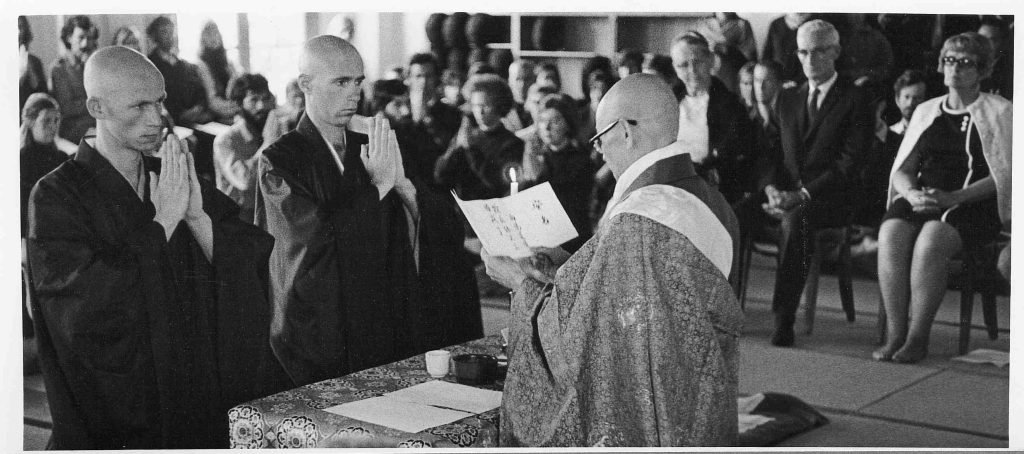
Immediately following these studies, he moved to Chicago, where he founded the Zen Buddhist Temple of Chicago. In addition to teaching meditation (zazen), Matsuoka-roshi extended his activities beyond the temple. He lectured extensively to local high schools and colleges, and served as an instructor of zazen for the Chicago Judo-Karate School, and later as a special instructor at the Colorado State University and Chicago Central YMCA College.
Beginning in 1968, he made a yearly tour of Japan. His initial tour was sponsored by the U.S. Embassy to Japan, during which he lectured on the topic of “Unknown America” in order to promote cultural understanding. In 1971, he established the Long Beach Zen Buddhist Temple. His life was dedicated to establishing Soto Zen in America.
He frequently quoted a saying: “Moku-rai.” It means “silence is thunder.” Much of what one learned from Sensei (“teacher”), as his disciples called him, was not from preaching, but from his manner, the way he expressed himself through his attitude and actions. His Zen dharma was transferred silently, naturally, through his presence. The core of his teachings is the practice of zazen, Zen meditation, and the realization of its power in daily life. His disciples lead temples around the USA and Canada.
Eulogy
Reverend Kozen Sampson
Eulogy of the late Rev. Dr. Soyu Zengaku Matsuoka, Roshi
25 November 1912 – 20 November 1997
Matsuoka Roshi was born in Japan into a family who had been Zen priests for over six hundred years. He attended Komazawa University in Tokyo, where he graduated with a bachelor’s degree, then I believe that he attended the University of Tokyo, earning a Ph.D. in political science. I think he also did advanced graduate study at Columbia University in New York under his friend and mentor, Dr. D. T. Suzuki.
Matsuoka Sensei was a black belt in the martial arts of Jujitsu and Karate. He studied Zen in several temples including Sojiji Monastery.
In Japan, Rev. Matsuoka served at several local temples as well as establishing a temple in Northern Japan. Soto Zen Headquarters assigned Matsuoka Roshi to travel to America as an assistant priest of the Los Angeles Zen Center.
His next assignment was as the supervisor of the San Francisco Zen Buddhist Temple (which later developed into the San Francisco Zen Center). He eventually went on to found the Zen Buddhist Temple of Chicago and, in 1971, the Long Beach Zen Buddhist Temple. His early translations of sutras and ceremonies were literary works of spirit that allowed him to explain the treasures of Dharma to students who were unable to read Japanese.
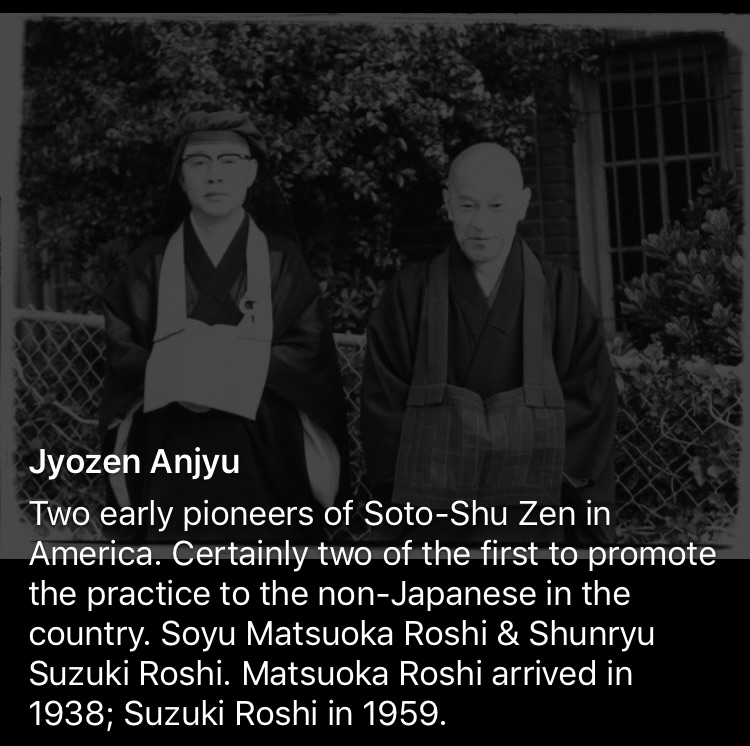
There is a story that while in San Francisco, Matsuoka Sensei requested help dealing with the great influx of individuals who were overwhelming the Zen resources. Reportedly, Soto Zen Shu in Japan sent Rev. Shineru Suzuki, who later wrote a wonderful book, Zen Mind, Beginner’s Mind.
The Rev. Dr. Matsuoka lectured to many schools and organizations in the U.S. He also toured Japan fairly regularly, lecturing about Zen and the U.S. He was sponsored by the U.S. Embassy for tours of Japan promoting cultural understanding of the “Unknown American.”
Sensei’s (respected teacher) Zen was direct, fierce, and his life was passionate. Matsuoka Roshi taught that all life, everything, is training, that everything is Zen. “Zen is daily life and Zen is action!” and “Every day is a happy day,” he would say. When asked about dealing with life, he once said, “Be kind, respectful, honest and continue seeing everything and everyone as Buddha — if you can’t manage all that right now, sit some more and keep training.” He would tell his students, “Stop foolish actions, train, sit!”
Matsuoka Roshi spoke of the great transitions of Zen, starting with Shakyamuni Buddha in India and then to China, Japan, and now the U.S. and other Western countries. “American Zen will carry the same flavor and essence as Shakyamuni’s original teachings,” he said, “as well as the Chinese and Japanese flavors, yet will become its own special form of Zen.”
In support of this vision, he did not register his ordained or transmitted priests with Soto Zen Headquarters in Japan. Rather, he gave his instructions to each one and sent them out to spread the Dharma.
According to Soto Zen Shu headquarters in Japan, Matsuoka registered 4 priests with them. These registrations were as an initial novice priest status. This status lasts for 10 years and then expires unless a candidate performs a successful shu-so period of training. I did not see any additional record of Matsuoka Roshi registering anything more for these individuals with Soto Shu.
- Kongo Langlois
- Ken McGuire
- Fern McGuire
- Michael Elliston
According to the records from the Long Beach Zen Center and my own personal knowledge, Matsuoka Roshi conferred the degree of Inka Shomei, Dharma Transmission, upon at least 3 individuals as well as:
- Kongo Langlois
- Ken McGuire (I have the original document)
- Johndennis Govert (I have seen the original document)
I have either seen written proof or heard directly from Matsuoka Sensei that these individuals were considered to be fully transmitted priests with the status of Roshi by him. There may be others.
According to my knowledge, I have actually seen the documentation of conferring full Zen Priesthood upon the following individuals:
- Ken McGuire
- Fern McGuire
- Johndennis Govert
- Wayne Tourda
- Reverend Daito Zenei Eric Thompson — Osho, director Sarasota Zen Center — Zen Buddhist Temple
In addition I have seen newsletter, letters, lists or other Matsuoka Roshi generated writing with all of these individuals indicated as ordained priests. There may be others. There are some others that I believe to have been ordained by Rev. Matsuoka but I have not personally heard Sensei state their names or seen their certificates.
When Sensei told me I had completed his version of Shu-so I knew what he meant as I had been trained some for the position while I studied in Japan. I was also aware of Transmission and how that ceremony and practice was done in Japan. When I asked Sensei why his practice differed so much from the Soto shu practices in Japan he responded, “While much in Japan is exactly correct, this is America and we must here do American Zen – not so fussy.”
To the best of my knowledge Sensei bought priest robes for Ken Roshi and myself, I do not know of any other robes he bought for any other students. He did not ask his student to wear the Kesa but did have them wear a Rokasu. Rokasus were bought from a Japanese sewing company or religious supply store. I have a Rokasu that Sensei bought for me.
Sensei was a powerful presence. He could be fierce and he could be gentle. He was devoted to the Dharma and to his students. He lived simply and taught directly. His life was the teaching.